What Plastic Is Best for Injection Molding? A Material Selection Guide
Justin Brown
April 9th, 2026
Your part is designed. Your CAD file is clean. But one question stands between you and production: what plastic are you running?
That choice affects more than cost. It determines whether your part holds its shape under heat, survives chemical exposure, or meets the tolerance your assembly requires. Pick the wrong resin and you may end up with warped parts, failed fits, or a material your molder can’t source on your timeline.
There are hundreds of plastic resins available for injection molding. Most projects only need one — the right one. The challenge is narrowing down your options before you send your files to a manufacturer.
This guide covers the plastics most commonly used in plastic molding, what each one does well, and how to match your part’s requirements to the right resin. We’ll walk through a selection framework, review the top materials by property and application, and look at specialty blends worth knowing. By the end, you’ll know what to bring to your first conversation with a manufacturer — and why.
What are the Best Plastics for Injection Molding?
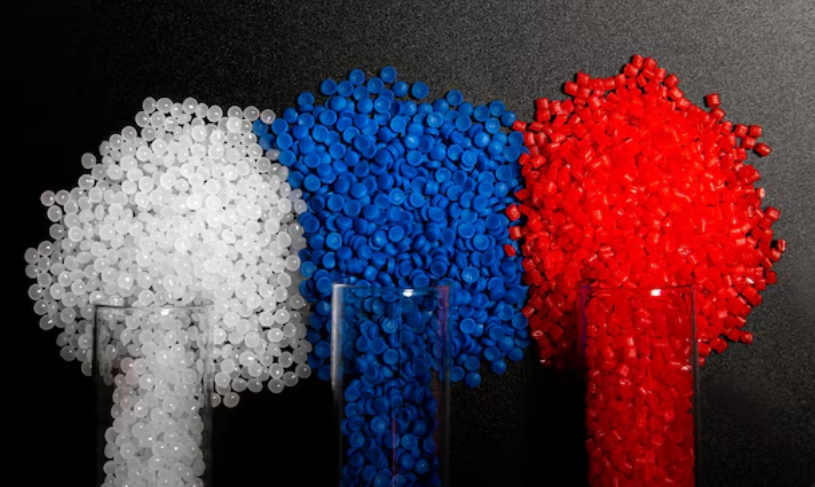
The most widely used plastics for injection molding are polypropylene (PP), ABS, nylon (PA), polycarbonate (PC), polyethylene (PE), and acetal (POM). Each material fits different performance needs:
Polypropylene (PP) — flexible, chemical-resistant, low cost; ideal for consumer goods and packaging
ABS — rigid, impact-resistant, easy to process; common in electronics housings and automotive parts
Nylon (PA) — strong, wear-resistant, handles heat; used in gears, brackets, and mechanical components
Polycarbonate (PC) — optically clear, high-impact strength; used in lenses, guards, and medical devices
Polyethylene (PE) — soft, chemical-resistant, food-safe grades available; used in containers and fittings
Acetal (POM) — dimensionally stable, low friction; used in precision mechanical parts
The best choice depends on your part’s load requirements, operating environment, and production volume.
How to Choose the Right Plastic for Injection Molding
Start with where your part will live. A component that sits inside a climate-controlled enclosure has very different needs than one exposed to engine heat, cleaning chemicals, or direct sunlight. Before you look at any resin, answer these four questions:
What temperatures will the part face? Some plastics soften at relatively low heat. Others hold their shape well past 200°F.
What chemicals or fluids will it contact? Certain resins break down with prolonged exposure to oils, solvents, or cleaning agents.
What kind of load will it carry? Static loads, repeated flex, and impact forces each favor different material families.
Will it face UV exposure? Standard ABS, for example, degrades outdoors without UV stabilization.
Production volume is the next filter. Some resins are straightforward to run at high volumes and keep cost-per-part low. Specialty grades or engineering resins may add material cost that only makes sense for lower-volume or high-performance applications.
Tolerance requirements matter too. Every resin shrinks as it cools inside the mold. Some shrink more than others — and shrink rate directly affects whether your part hits its dimensional targets. Your molder should account for this when designing the tool.
Finally, check for regulatory requirements early. If your part contacts food, goes into a medical device, or needs a specific flame rating, entire material families may be eliminated before you ever compare properties. Knowing your compliance requirements upfront saves time and avoids costly material changes after tooling has started.
With that framework in place, here’s how the most common resins stack up against each other.
The Most Common Plastics Used in Injection Molding
Most injection-molded parts are made from a small group of well-understood resins. Each one has a clear performance profile. Here’s how they compare:
Polypropylene (PP) — One of the most widely produced plastics in the world. Low cost, good chemical resistance, and strong fatigue performance. PP is also capable of a “living hinge” — a thin flex point that, when properly designed, can flex millions of times without breaking. Common in packaging, consumer goods, and automotive components.
ABS — Rigid, impact-resistant, and easy to process. ABS produces a clean surface finish and accepts paint and plating well. It’s a go-to for consumer electronics housings, automotive trim, and enclosures.
Nylon (PA) — High strength-to-weight ratio, good wear resistance, and handles elevated temperatures well. Nylon is hygroscopic, meaning it absorbs moisture from the air. It must be dried before processing to avoid defects in the finished part.
Polycarbonate (PC) — Optically clear and exceptionally impact-resistant. PC requires higher processing temperatures than most resins and costs more, but delivers performance that few materials can match for lenses, guards, and transparent housings.
Polyethylene (PE) — Soft, flexible, and chemically resistant. Food-safe grades are available. HDPE is stiffer and used in containers and fittings; LDPE is softer and used in films and squeeze applications.
Acetal (POM) — Dimensionally stable, low friction, and well-suited for tight tolerances. POM performs well in precision mechanical parts and moving components. It is not compatible with strong acids and oxidizing agents. (Note for client review: confirm POM is among the resins you run before publishing)
We at Freeform Polymers run PP, ABS, nylon, PC, PC/ABS, ASA, TPU, TPE, and PVC — so if your material is on this list, we can work with it. If you’re not sure yet, that’s a conversation we’re set up to have.
Knowing what each material does is one piece of the puzzle — knowing where it fits in a finished product is the other.
Materials Matched to Common Applications
Choosing a resin gets easier when you start with the application instead of the material list. Here’s a quick reference for common part categories and the resins that fit them best:
Application Type
Recommended Resin(s)
Automotive / under-hood components
Nylon (PA), PP, Acetal (POM)
Consumer product housings
ABS, PC/ABS blend
Medical devices / food contact
Medical-grade PE, PC, PP
Precision mechanical / moving parts
Acetal (POM), Nylon (PA)
Transparent / optical parts
Polycarbonate (PC), Acrylic (PMMA)
Outdoor / weathering exposure
ASA, UV-stabilized PP
A few of these are worth expanding on.
Automotive under-hood parts face heat cycles, vibration, and fluid exposure all at once. Nylon and POM handle that combination better than general-purpose resins. For cosmetic exterior parts, ABS and PC/ABS blends give you the surface quality and impact resistance that automotive applications demand.
Medical and food-contact parts have a short list — compliance requirements do most of the filtering. PP, PE, and PC all have medical-grade and food-safe variants, but you’ll need to confirm the specific grade meets your regulatory requirements before locking in a material.
For precision moving parts, dimensional stability matters as much as strength. POM holds tight tolerances and has a naturally low friction surface, which makes it a reliable choice for gears, cams, and sliding components. Nylon works well here too, though its moisture absorption means you’ll want to account for dimensional change in humid environments.
We work with buyers across industries to match materials to applications.
Once you know your candidate material, the next step is making sure your molder can actually run it — and that your part design works with it.
Specialty and Blended Resins Worth Knowing
Standard resins cover most applications. But some parts need properties that a single base resin can’t deliver on its own. That’s where blends and specialty materials come in.
PC/ABS blend — Combines polycarbonate’s impact strength with ABS’s ease of processing. This blend is widely used in automotive interior trim and consumer electronics where you need both toughness and a clean cosmetic finish.
TPU (Thermoplastic Polyurethane) — Flexible, abrasion-resistant, and tough. TPU is a good fit for seals, grips, and wearable components that need to flex repeatedly without cracking.
TPE (Thermoplastic Elastomer) — Softer than TPU and well-suited for over-molding applications. TPE bonds to rigid substrates in a two-shot or insert molding process, making it common in handles, grips, and soft-touch surfaces.
ASA (Acrylonitrile Styrene Acrylate) — Performs like ABS but holds up outdoors. ASA resists UV degradation without requiring a secondary coating, making it a practical choice for enclosures and components with direct sun exposure.
Glass-filled nylon — Adding glass fiber to nylon dramatically increases stiffness and raises the heat deflection temperature. It’s a strong choice for structural components under load. The tradeoff: glass-filled resins are abrasive. They accelerate wear on mold surfaces faster than unfilled resins, which affects tooling maintenance schedules and long-term mold cost.
That last point matters more than most buyers realize. The resin you choose doesn’t just affect your part — it affects your tooling. A mold designed for unfilled nylon will wear differently than one running glass-filled grades. Your molder should flag this during the design phase, not after the tool is already built.
Once you’ve identified a candidate material, the next step is making sure your molder can actually run it — and that your part design works with it.
What Your Injection Molder Needs to Know Before You Lock In a Material
Material selection doesn’t happen in isolation. The resin you choose has to work with your part design and your mold — and those three things interact in ways that aren’t always obvious until someone with tooling experience looks at your file.
Here’s what a good molder will want to review before you finalize your material spec:
Wall thickness — Uniform walls help resin flow evenly and cool consistently. Some materials are more forgiving of variation than others. Thin walls in a high-viscosity resin like PC can cause incomplete fills.
Draft angles — Every resin shrinks as it cools. Draft angles help the part release cleanly from the mold. The right angle depends partly on the material and partly on the surface finish you need.
Gate placement — Where the resin enters the mold affects how it flows, where weld lines form, and how stress is distributed in the finished part. This matters more with some resins than others.
Material sourcing and lead times — Standard grades of PP, ABS, and nylon are generally easy to source. Specialty grades, medical-grade materials, and some filled resins can have longer lead times. Confirm availability before your mold is built.
The right time to validate your material choice is during a Design for Manufacturability (DFM) review — before tooling starts. Changes after a mold is cut are expensive. Changes on paper are not.
We review CAD files for material compatibility, wall thickness, draft, and gate placement as part of every quote. Our process is built around catching these issues early, when they’re still easy to fix. As an ISO 9001:2015 certified facility, we maintain material traceability throughout production — so you always know exactly what resin went into your parts.
Bring your CAD file and your material questions — we review both.
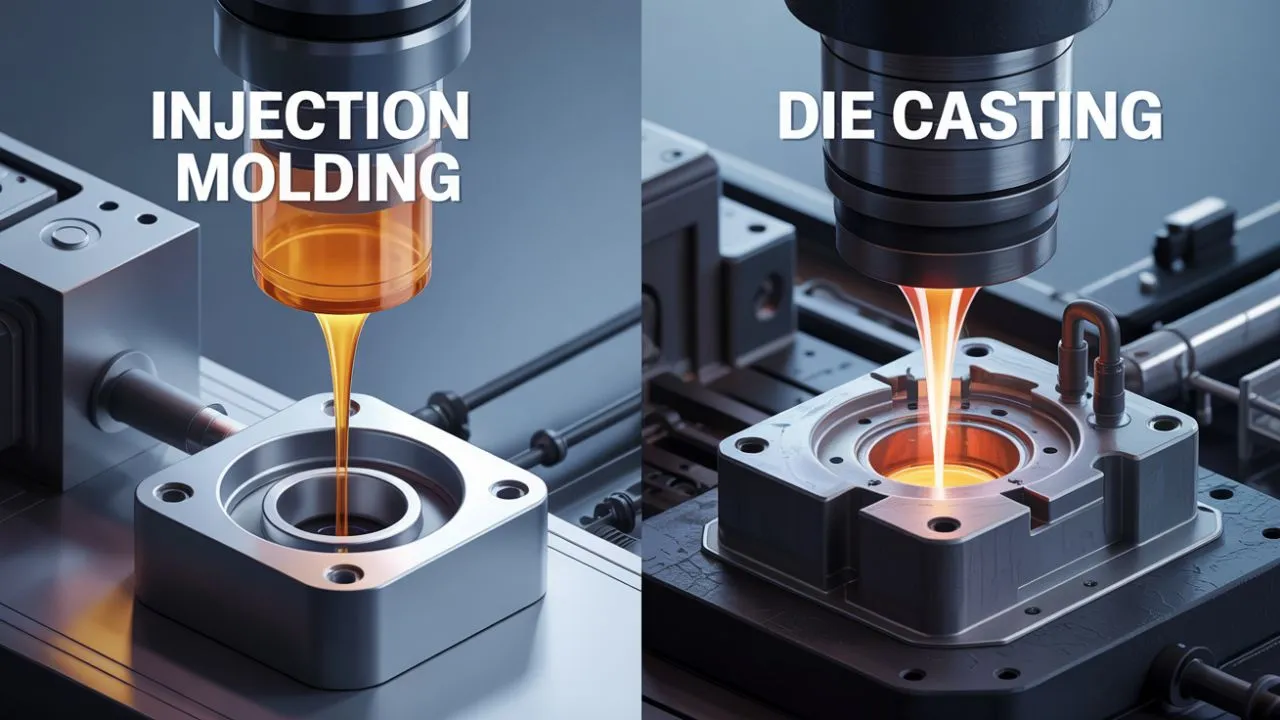
Should your part be plastic or metal? That question decides whether you need injection molding or die casting. Both processes push melted material into a mold under pressure. From across…
Is it cheaper to build your mold overseas or here at home? The honest answer depends on what you actually count. Many buyers compare domestic vs overseas injection molding using…
You have a part to make. Someone mentioned CNC turning or CNC milling. Maybe both came up. They sound alike, but they are not the same process. Picking the wrong…
You’ve probably seen the letters “ISO 9001:2015” on a badge or a website. It might look like just another logo. But it means something specific. ISO 9001:2015 certification tells you…
If you’ve gotten quotes from two injection molding companies, you may have noticed something. One mentions a hydraulic machine. The other mentions an electric machine. You might wonder if that…
Combining metal with plastic takes a different process than adding a soft grip to a hard plastic part. Both are common in insert molding and overmolding, but they solve different…
Not all injection molds are built the same way. At Freeform Polymers, we’ve seen how the type your part needs can change your tooling cost by thousands of dollars. That…
Ever gotten a design review back with a flag that says “insufficient draft”? You had no idea what that meant. It’s one of the most common notes molders give on…