How Long Does Plastic Injection Molding Take? Mold Build to Production Timeline
Justin Brown
November 20th, 2025
Will your injection mold be ready in 4 weeks or 16? For product developers and procurement teams, that 12-week difference can mean hitting a market window or watching competitors launch first. Simple two-plate molds average 6–8 weeks from design lock to first shot, while complex multi-cavity tools can stretch 12–20 weeks. [Citation needed: Industry benchmark data] The gap isn’t just about shop speed—it’s about decisions you make before the first cut of steel.
Three quotes, three wildly different timelines: 5 weeks, 10 weeks, 18 weeks. When evaluating plastic injection molding service providers, timeline estimates often vary more than price quotes. Mold fabrication isn’t a single linear process. It’s a series of interdependent steps where design complexity, material availability, and your approval speed all play a role.
This guide breaks down realistic timelines for plastic injection molding service projects—from prototype tools to high-volume production molds—so you can plan accurately and identify which variables you control. We’ll walk through typical timeframes by mold type, explain the 6-stage fabrication process that drives those numbers, and show you exactly where delays happen and how to avoid them.
How Long Does It Take to Build an Injection Mold?
Injection mold fabrication typically takes 4–20 weeks depending on complexity:
Material procurement (1–3 weeks) – Tool steel, components ordered
Machining (2–10 weeks) – CNC work, EDM, polishing
Assembly & testing (1–2 weeks) – Fit, first shots, adjustments
Sampling & approval (1–2 weeks) – Client sign-off on parts
Realistic Timeline Benchmarks for Injection Mold Fabrication
Understanding injection mold fabrication time starts with knowing which type of tool your project needs. Different mold designs serve different production goals, and each comes with its own timeline.
Simple prototype molds take 4–6 weeks to build. These are single-cavity tools made from aluminum with no complex actions. We use them for design validation and low-volume testing. If you need 500 parts to test market fit before committing to full production, this is your fastest path.
Standard production molds require 8–12 weeks. These are 2–4 cavity tools made from hardened steel using two-plate designs. They handle mid-volume production runs—anywhere from 10,000 to 500,000 parts per year. Most commercial products fall into this category.
Complex production molds stretch to 12–20 weeks. These tools have 8 or more cavities, hot runner systems, and side actions. They’re built for high-volume automotive and consumer goods manufacturing. The additional time covers the intricate machining required for undercuts and automated gating.
Family molds add 2–4 weeks to any comparable complexity tier. When you need multiple part geometries in one tool, we machine separate cavities for each component. The extra time covers designing proper runner balance and ensuring consistent fill across different part sizes.
Mold Type
Typical Timeline
Cavity Count
Best For
Relative Cost
Simple Prototype
4–6 weeks
1 cavity
Design validation, <5K parts
$
Standard Production
8–12 weeks
2–4 cavities
Mid-volume runs (10K–500K/year)
$$
Complex Production
12–20 weeks
8+ cavities
High-volume manufacturing
$$$$
Family Mold
Add 2–4 weeks
Varies
Multiple parts in one tool
$$$
The 6 Stages of Injection Mold Manufacturing (And What Takes Longest)
Those timelines aren’t arbitrary—they’re the sum of six distinct manufacturing stages. Here’s where those weeks actually go.
Stage 1: Design finalization & DFM takes 1–2 weeks. This is where we review your CAD files and provide design-for-manufacturability feedback. The hidden bottleneck? Client approval delays. Every revision round adds another week to the timeline. [Citation needed: Case study or project management data] Locking down your design before we start machining saves significant time.
Stage 2: Material procurement requires 1–3 weeks. Pre-hardened steel ships faster than exotic alloys. If your part needs stainless steel or beryllium copper inserts for heat management, expect the longer end of that range. Standard P20 or H13 tool steel usually arrives within 7–10 days.
Stage 3: CNC machining & EDM consumes 2–8 weeks. This is the longest stage of mold fabrication. Complexity drives duration. Simple cavities with draft angles machine quickly. Undercuts requiring electrical discharge machining, fine surface details, and polished finishes all extend this stage. A textured surface that needs EDM can add 3–7 days alone.
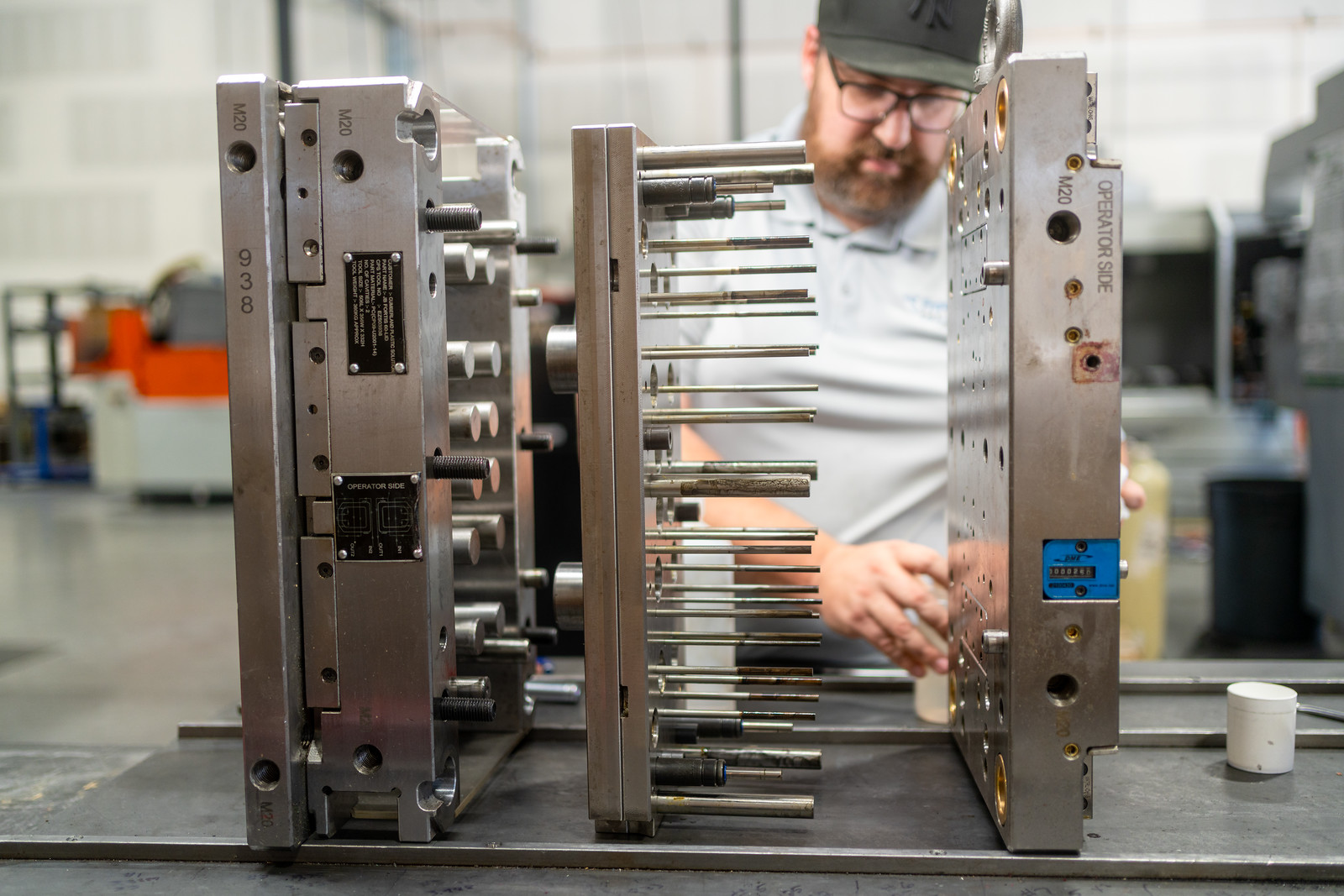
Stage 4: Mold assembly takes 3–5 days. We fit the core and cavity halves together, install the ejector system, and test cooling lines for leaks. This stage moves fast because the precision work happened during machining.
Stage 5: First shots & adjustments spans 3–7 days. This is iterative work. We run sample parts, measure them against your specifications, and tweak the steel to hit tolerances. Parts with tight dimensional requirements need more refinement cycles.
Stage 6: Final approval & delivery requires 2–5 days. Your approval speed matters here. Once you sign off on sample parts, we prepare the mold for shipment or production.
Stage
Duration
Main Activities
Client Action Required
Design finalization & DFM
1–2 weeks
CAD review, design feedback
Approve changes, lock design
Material procurement
1–3 weeks
Order tool steel, components
None (unless material substitution needed)
CNC machining & EDM
2–8 weeks
Cut steel, polish surfaces, EDM details
None
Mold assembly
3–5 days
Fit components, install ejectors, test cooling
None
First shots & adjustments
3–7 days
Sample parts, measure, refine
Review samples, request changes
Final approval & delivery
2–5 days
Package mold, prepare documentation
Sign off on samples
8 Factors That Add Weeks to Your Mold Build Timeline
Understanding the stages explains the baseline. But why does the same “standard production mold” take one shop 8 weeks and another 14? These variables drive the spread.
Part geometry complexity extends timelines significantly. Every undercut requiring a side action adds 1–2 weeks to machining time. Every textured surface requiring EDM adds 3–7 days. Simple geometries with consistent wall thickness and natural draft angles machine faster than parts with complex internal features.
Tolerance requirements double inspection and refinement time. Parts requiring ±0.001″ tolerances need more measurement cycles and slower machining speeds than parts with ±0.005″ tolerances. Tighter tolerances mean more time verifying dimensions and adjusting steel between sample shots.
Material selection affects both steel choice and machining duration. Engineering resins like PEEK and Ultem require specialized tool steel that machines slower. [Citation needed: Material supplier technical data] Standard commodity resins like polypropylene and ABS work with common tool steels that cut faster. According to the Plastics Industry Association, material compatibility with tooling is a key consideration in mold design standards.
Cavity count increases timeline by 30–40% when you double cavities. Going from 2 cavities to 4 doesn’t double the schedule because we share machining setups. But it does add substantial time for cutting additional cavities and balancing the runner system.
Design iteration during build can add 2–6 weeks. Changing a feature after machining starts means scrapping completed work and restarting that stage. A wall thickness change or vent location adjustment sounds minor but may require re-cutting cavity steel.
Vendor workload determines your queue position. Most shops quote lead time based on current capacity. A busy shop might slot your project 3 weeks out even before starting work. Ask explicitly about queue position and expedite options.
Testing requirements add 1–2 weeks for formal documentation. If you need process validation for ISO certification or medical device compliance, we run structured sampling protocols and document process parameters. This takes longer than standard first-article inspection.
Component lead times affect overall schedule when you need custom parts. Hot runner systems ship in 2–4 weeks. Specialty ejector pins, date stamps, or custom inserts may take 2–3 weeks to arrive. Standard components from stock add no delays.
Design Feature
Adds Time?
Typical Impact
Undercuts (side actions)
Yes
+1–2 weeks per action
Textured surfaces
Yes
+3–7 days per surface
Tight tolerances (±0.001″)
Yes
+1–2 weeks
Engineering resins (PEEK, Ultem)
Yes
+1–2 weeks
Multiple cavities (4+)
Yes
+30–40% vs. single cavity
Hot runner system
Yes
+2–4 weeks (component lead time)
Standard draft angles
No
Baseline timing
Simple two-plate design
No
Baseline timing
How to Shorten Your Injection Mold Lead Time (Without Sacrificing Quality)
You’ve seen what drives timelines. Now here’s how to control them. These tactics help you meet tight deadlines without cutting corners on mold quality.
Design for manufacturability upfront eliminates revision rounds. One DFM review before quoting can save 2–3 weeks by catching issues early. Share your CAD files with us during the concept phase. We’ll identify features that complicate machining and suggest alternatives that maintain function while speeding production.
Choose standard mold bases instead of custom designs. DME, PCS, and LKM standard frames ship within days. Custom base designs add 1–2 weeks for machining the mold frame itself. Standard bases cover 90% of applications and cost less too.
Approve stages quickly by setting internal response deadlines. Every delayed approval adds direct days to your timeline. Aim for 48-hour turnaround when we send sample parts or design questions. Build review time into your project schedule from the start.
Consider aluminum tooling for prototypes when production volumes stay moderate. Aluminum tooling reduces lead times by 20–40% compared to steel and works well for production runs under 100,000 parts. [Citation needed: Aluminum tooling lead time studies] We use aluminum for trade show samples, design validation, and bridge production. You get parts weeks earlier, and aluminum costs less upfront.
Pay for expedite or overtime work if deadline pressure justifies the cost. Most shops offer premium pricing for expedited delivery—ask explicitly about rush options and associated costs when requesting quotes. We’ll tell you honestly whether compressed timelines are realistic for your project.
Split tooling approach works for multi-cavity production molds. Start with a single-cavity tool for sampling while the full production tool builds in parallel. You get sample parts for testing in 4–6 weeks while the 8-cavity production mold finishes in week 12. This parallel path strategy keeps your project moving.
Strategy
Typical Time Saved
Trade-off to Consider
DFM review before quoting
2–3 weeks
Requires sharing CAD early in vendor selection
Standard mold bases
1–2 weeks
Less customization; may not fit unusual part layouts
48-hour approval SLA
1–2 weeks
Requires internal coordination and fast decision-making
Aluminum prototype tooling
20–40% lead time reduction
Best for moderate production volumes (under 100K parts)
Expedite/overtime fees
1–3 weeks
Premium cost for accelerated delivery
Split tooling (prototype + production)
Access to parts 6–8 weeks earlier
Higher total tooling cost; two separate tools
Facing a tight deadline? Call us at (435) 774-9090 to discuss expedite options and realistic timelines for your project.
Questions to Ask Your Injection Molding Service About Timelines
You’ve seen what’s possible. Now make sure your vendor can actually deliver it. Ask these questions before signing a purchase order.
“What’s your current queue, and where would my project slot in?” Honest answers reveal whether quoted timelines are realistic or aspirational. A shop quoting 8 weeks but with a 4-week queue means 12 weeks minimum. We tell you upfront where you fall in our schedule and whether we have capacity to meet your deadline.
“Do you machine in-house or subcontract EDM and polishing?” Subcontracted work adds handoff delays—often 1–2 weeks per transfer. [Citation needed: Supply chain analysis] Shops that handle CNC, EDM, and polishing under one roof control the entire timeline. Ask specifically about which operations leave the building.
“What’s your typical design change policy once machining starts?” This clarifies cost and schedule impact of revisions. Some shops absorb minor tweaks. Others charge for any change after design lock. Understanding the policy helps you weigh whether last-minute improvements are worth potential delays.
“Can you show examples of similar mold timelines you’ve hit?” Past performance beats promises. Ask for 2–3 projects comparable to yours in complexity and cavity count. Actual delivery dates show whether the shop consistently meets quoted schedules or tends to run long.
“What’s your communication cadence during the build?” Weekly updates versus radio silence until delivery matters for project planning. You need to know if issues arise early—not in week 10 of an 8-week quote. Ask how they communicate progress and whether you can visit during key milestones.
Get transparent timeline estimates based on your part complexity. Call us at (435) 774-9090 or visit our contact page to discuss your production deadline.
Conclusion
Injection mold timelines vary from 4 to 20 weeks based on factors you can control. Part complexity, design decisions, material selection, and your approval speed all influence how quickly your mold moves from concept to first shot. The best vendors work with you to optimize timelines without cutting corners on quality.
Understanding the six-stage fabrication process helps you plan accurately. You know where time gets spent and which decisions add weeks to your schedule. Ask the right questions upfront. Review designs early. Approve stages quickly. These actions give you the best chance of meeting your production deadlines.
Need a precise timeline for your project? Explore our plastic injection molding services or contact Freeform Polymers at (435) 774-9090 to get a timeline estimate based on your part design. You can also visit us at 2350 Main St #2, North Logan, UT 84341. We serve manufacturers throughout Northern Utah and Southern Idaho with transparent timelines and reliable delivery.
You need 400 parts for a product launch. The first quote comes back with a 10,000-part minimum. Now you face a hard choice. You can buy parts you don’t need,…
Your circuit boards are finished. Your enclosure is molded. Screws, cables, and labels are coming from four different suppliers. Someone still has to turn that pile of parts into one…
You asked for a smooth, nice-looking part. Then the samples came back shiny, and every fingerprint and tiny dent showed. The mold did exactly what it was told. It just…
Your first sample parts look great until you flip one over. There’s a rough nub right on the face your customer sees first. That nub is where the plastic came…
Your first sample parts just came back. They look right until you tilt one toward the light. Then you see it: a shallow dent sitting right over a rib. Nothing…
Your CAD model says 25.00 mm. Your first molded parts come back at 24.93 mm. Is that a problem, or is it normal? The answer depends on the tolerance you…
A part passes inspection and ships out on time. Weeks later, it cracks after a solvent wipe or a tightened bolt. Nothing was wrong with the design. The stress was…