How Large Can Injection Molding Parts Be? (Size Limits & Capabilities Guide)
braydonpaul
November 10th, 2025
A product engineer contacts three injection molding shops with a 36-inch automotive part design. Two immediately say it’s too large. The third quotes $85,000 for tooling alone. Understanding size limits before design lockdown could have saved months and significant budget.
How large can you injection mold? The answer isn’t a single number. It depends on your part’s footprint, wall thickness, material, and the tonnage capacity of available molding machines.
This guide explains injection molding size limitations. We cover how machine tonnage determines maximum part dimensions. You’ll learn when to consider alternative processes for custom injection molding near me searches.
You’ll discover typical size ranges for standard and large-format injection molding. We explain the key factors that constrain part dimensions. You’ll learn how to work with local providers to determine feasibility for your specific project. By the end, you’ll know if injection molding fits your part size and what equipment capacity you need.
How large can you injection mold?
Injection molding can produce parts ranging from tiny components under 1 gram to large items exceeding 50 pounds and several feet in length, depending on machine capacity.
Standard injection molding machines (50–500 tons) typically handle parts up to 24 inches in their longest dimension with footprints around 200–400 square inches. Large-format machines (500–4,000+ tons) can mold parts up to 6 feet or larger, though costs increase significantly with size.
The practical size limit depends on four factors: machine tonnage (clamping force), injection capacity (shot size), part geometry (wall thickness and complexity), and economic feasibility (larger molds cost exponentially more). Most custom injection molding projects fall between 2–24 inches for optimal cost-efficiency.
Injection Molding Size Ranges: From Micro to Large-Format
Injection molding serves an enormous range of part sizes. Understanding these categories helps you determine which equipment class your project requires.
Micro molding produces parts under 1 gram with sub-millimeter features. These tiny components appear in medical devices, electronics connectors, and precision instruments. Micro molding requires specialized equipment with extreme precision controls.
Small to medium parts range from 1 ounce to 2 pounds and measure up to 12 inches in their longest dimension. Most consumer products fall in this category. Phone cases, kitchen utensil handles, automotive interior components, and medical device housings typically fit these dimensions.
Standard large parts weigh 2–25 pounds and span 12–36 inches. Appliance housings, outdoor equipment components, and industrial parts occupy this range. These parts require mid-range tonnage machines that most injection molding facilities operate.
Large-format molding handles parts from 25–100+ pounds measuring 36–72+ inches. Automotive body panels, agricultural equipment components, and large furniture parts need specialized high-tonnage equipment. Few facilities offer this capability due to equipment costs.
In our Logan-area custom projects, we most commonly see requests in the 4–18 inch range. These parts balance design flexibility with cost-effective tooling and standard machine availability.
Size Category Reference
Size Category
Weight Range
Typical Dimensions
Machine Tonnage
Example Parts
Micro
<1 gram
Sub-mm to 1″
5–50 tons
Medical components, micro gears
Small-Medium
1 oz–2 lbs
1–12 inches
50–200 tons
Phone cases, handles, containers
Standard Large
2–25 lbs
12–36 inches
200–800 tons
Appliance housings, equipment parts
Large-Format
25–100+ lbs
36–72+ inches
800–4,000+ tons
Automotive panels, furniture
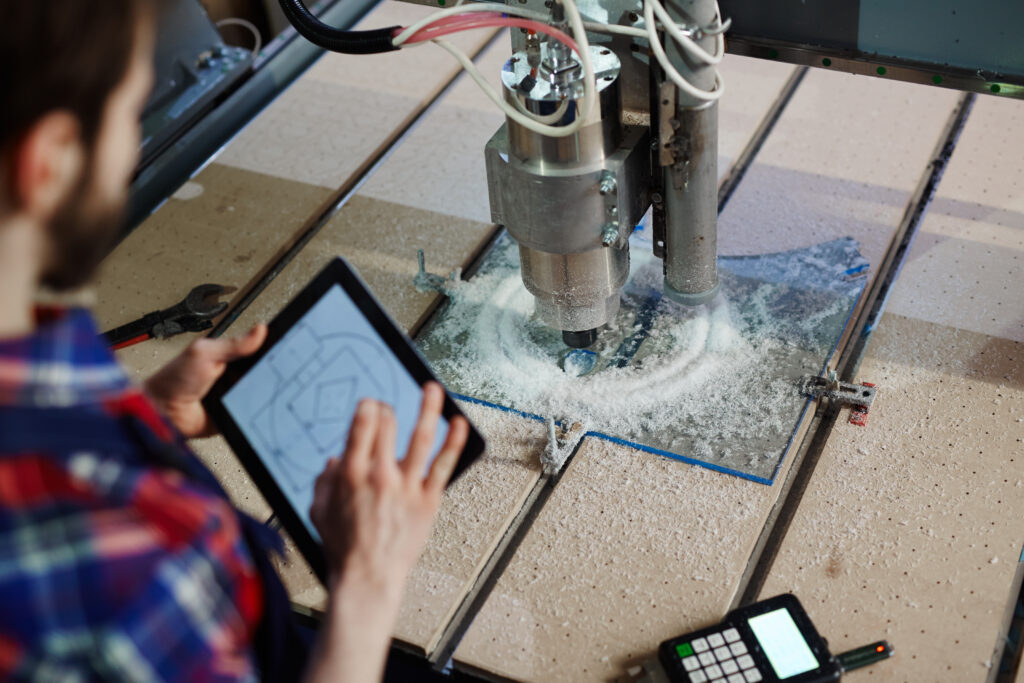
Engineer with touchpad and lathe machine
How the Injection Molding Process Affects Part Size
Understanding the injection molding process helps explain why size limitations exist. These constraints come from physics and equipment capabilities, not arbitrary rules.
The basic process injects molten plastic under high pressure into a closed mold cavity. The machine clamps the mold shut while plastic fills every detail. After cooling, the mold opens and ejects the finished part. This simple description hides complex forces that determine maximum part size. Learn more about plastic part design from UMass Lowell’s Plastics Engineering program.
Clamping force fundamentals drive the first major limitation. When plastic enters the mold under pressure, it tries to push the mold halves apart. The machine’s tonnage must overcome this internal cavity pressure across the entire projected part area. Insufficient clamping force causes flash, short shots, or mold damage.
Shot size capacity creates another boundary. The machine’s injection unit must melt and deliver enough material volume in one cycle. A large part requiring 10 pounds of plastic cannot run on a machine with a 5-pound shot capacity. The barrel and screw dimensions limit maximum shot size.
Cooling considerations affect part size economics. Larger parts require longer cooling times before ejection. Thick sections take even longer to solidify completely. Extended cycle times reduce efficiency and increase per-part costs. This makes very large parts less economical even when machines can physically produce them.
Mold size constraints add physical boundaries. The mold’s dimensions must fit between the machine’s platens. Tie-bar spacing determines the maximum mold width and height. Very large molds simply won’t fit in standard machines regardless of tonnage.
Rule of thumb: Required tonnage equals projected part area (square inches) times 2–8 tons per square inch. The exact multiplier depends on material type and wall thickness. This formula helps estimate equipment needs before detailed engineering.
Key Limitations for Large Injection Molded Parts
Several specific factors constrain maximum part size in injection molding. Understanding these limitations helps you design within practical boundaries and avoid expensive surprises.
Machine tonnage ceiling represents the most common constraint. Most injection molding shops operate machines between 50 and 500 tons. This equipment handles the majority of industrial and consumer products efficiently. Machines over 1,000 tons exist but remain specialized and expensive. Finding a facility with 2,000+ ton capacity limits your geographic options significantly.
Projected area calculation determines required tonnage. Projected area means the part’s footprint viewed from the mold’s parting line perspective. A flat plate 20 inches by 20 inches has 400 square inches of projected area. At 5 tons per square inch, this requires 2,000 tons of clamping force. Even tall parts with small footprints need less tonnage than large flat parts.
Material flow distance limits thin-wall large parts. Molten plastic can only flow 150–300 times the wall thickness before it freezes and stops flowing. A part with 0.080-inch walls allows roughly 12–24 inches of flow distance. Large parts need thicker walls or multiple gate locations to fill completely. This adds weight and material cost.
Mold cost escalation becomes severe with size. Tooling costs increase exponentially as molds grow larger. A mold for a 6-inch part might cost $8,000. A mold for a 30-inch part can easily exceed $60,000. The steel weighs more, machining takes longer, and handling requires special equipment. Heat treatment and finishing costs multiply with mold mass.
Part warpage risks intensify with size. Large flat sections cool unevenly and warp. Thin walls over large areas lack rigidity. Thick sections develop sink marks as interior material shrinks. Temperature variations across the mold create dimensional instability. These issues require expensive mold modifications or acceptance of looser tolerances.
We frequently advise clients when their initial design exceeds practical size limits. Often, breaking a large part into two or three smaller components provides better results. Assembly adds a step, but individual molds cost less and quality improves.
A 30-inch diameter flat tray with 0.125-inch walls requires approximately 450–700 tons of clamping force and $40,000–$60,000 in tooling. Breaking the same part into two interlocking halves might need only 250 tons per half at $25,000 per tool. Total tooling costs drop to $50,000 and you gain scheduling flexibility by running both molds simultaneously on smaller machines.
Machine Tonnage and Part Size Calculator
Estimating required tonnage helps you determine which machines can produce your part. This calculation guides conversations with injection molding providers and prevents mismatched equipment quotes.
Tonnage categories define equipment classes. Machines from 50–150 tons handle small parts like caps, closures, and handheld device components. The 150–500 ton range covers medium parts including automotive interior components, appliance parts, and packaging containers. Large machines from 500–1,500 tons produce outdoor equipment housings, furniture components, and industrial parts. Extra-large machines above 1,500 tons tackle automotive body panels and agricultural equipment.
Calculating projected area starts your tonnage estimate. Measure your part’s length and width from the mold parting line perspective. Multiply these dimensions to get square inches. A rectangular part 15 inches long by 10 inches wide has 150 square inches of projected area. Circular parts use the standard area formula. Complex shapes require CAD software to calculate accurate projected area.
Material multiplier factors adjust your tonnage estimate. Engineering resins like polycarbonate and nylon require 5–8 tons per square inch due to high melt viscosity and flow resistance. Commodity resins like polypropylene and polyethylene need only 2–4 tons per square inch because they flow more easily. Glass-filled materials add 1–2 tons per square inch to account for increased viscosity.
Design features that add tonnage push requirements higher. Deep ribs create localized pressure spikes. Thick sections generate more internal pressure during packing. Tight tolerances demand higher injection pressure for complete fill. Multiple cores or side actions increase projected area beyond the basic part footprint. Each feature adds 10–30% to baseline tonnage requirements.
How to request tonnage from providers should be your first technical question. Ask: “What tonnage range do your injection molding machines cover?” This single question qualifies whether a shop can handle your part size. If they operate 50–300 ton machines and you need 500 tons, you’ve saved everyone time by asking early.
Tonnage Estimation Example
For a part measuring 12″ × 8″ in polycarbonate with 0.125″ walls:
When to Consider Alternatives to Injection Molding for Large Parts
Injection molding excels at many applications, but other processes sometimes deliver better results for large parts. Recognizing when alternatives make sense saves money and improves outcomes.
Rotational molding crossover occurs around 36 inches for hollow parts. Rotomolding creates seamless large containers, tanks, and playground equipment without expensive high-tonnage molds. Production volumes between 100 and 5,000 units often favor rotomolding economics. The process handles parts up to 10 feet across. Tooling costs run 50–70% less than comparable injection molds. Cycle times are slower, but lower setup costs offset this for medium volumes. Learn about different types of plastic molding services to compare processes.
Thermoforming option suits very large, shallow parts. Trays, panels, equipment housings, and covers with relatively simple geometry cost less via thermoforming. The process heats plastic sheet and forms it over a mold using vacuum or pressure. Tooling runs $3,000–$15,000 compared to $40,000–$100,000+ for large injection molds. Surface detail and tolerance control don’t match injection molding, but many applications don’t require that precision.
Multi-part assembly approach breaks large designs into smaller molded components. Two or three interlocking pieces joined via ultrasonic welding, snap fits, or fasteners often cost less overall than one massive mold. Each smaller mold fits on standard equipment. Production flexibility increases because multiple machines can run simultaneously. Design iterations cost less when only one section needs mold changes.
3D printing for prototypes validates large part designs before tooling commitment. Large-format additive manufacturing produces full-size functional prototypes. You can test fit, assembly, and performance before investing $50,000+ in injection mold tooling. Some manufacturers use 3D printed parts for low-volume pilot production while ramping injection molding capacity.
Cost breakeven analysis determines when high-tonnage injection molding tooling pays off. Calculate total program costs across expected production volume. Include tooling, per-part costs, secondary operations, and assembly. Compare injection molding against alternatives at 500, 1,000, 5,000, and 10,000 unit volumes. The crossover point reveals which process delivers lowest total cost.
We recently recommended thermoforming over injection molding for a 48-inch equipment panel. The client needed 2,000 parts annually. Injection molding required a $75,000 mold and 1,200-ton machine time at premium rates. Thermoforming delivered acceptable quality with $8,000 tooling and $12 per part. Total program cost dropped from $95,000 to $32,000 over the three-year production run.
Finding Custom Injection Molding Near Me for Large or Complex Parts
Selecting the right local provider requires asking specific questions about equipment and capabilities. Not all injection molding shops can handle every part size.
Questions to ask local shops should start with equipment capacity. “What tonnage range do your injection molding machines cover?” tells you immediately if they can physically produce your part. Follow up with “What’s the largest part you’ve successfully molded?” for real-world capability proof. Ask “Do you have in-house tooling capabilities or do you outsource mold building?” because tooling lead times and communication improve dramatically with in-house capabilities.
Logan-area advantages for custom work include faster prototype iterations and collaborative design refinement. When your molding partner sits 20 minutes away instead of 2,000 miles away, you can visit for first-article inspection and design discussions. Changes happen in days instead of weeks. Lower shipping costs for heavy tooling and large parts improve project economics. You avoid international freight, customs delays, and time zone complications.
Equipment capabilities to verify extend beyond just tonnage numbers. Ask how many machines they operate and in what size ranges. Multiple machines provide scheduling flexibility and backup capacity. Secondary operations matter too. In-house assembly, pad printing, ultrasonic welding, and packaging reduce your vendor management burden. Fewer handoffs mean faster turnaround and better quality control.
Portfolio evaluation reveals practical experience. Request examples of parts similar in size and complexity to your project. Photos prove capability better than claims. Ask about the industries they serve. Medical device experience indicates quality systems and documentation rigor. Automotive background suggests high-volume efficiency. Consumer products experience shows cost optimization skills.
Design-for-manufacturability consultation should happen before tooling commitment. The best local providers offer upfront DFM review to optimize part size and cost. They identify draft angles, wall thickness issues, and gate locations that affect quality. This review catches expensive problems while changes cost nothing. After tool steel is cut, modifications become painful and costly. Our mold maker services include comprehensive DFM consultation.
In the Cache Valley region, most injection molding facilities run 100–500 ton machines ideal for parts up to 24 inches. These machines handle the majority of industrial and consumer products efficiently. For projects requiring larger tonnage, established local shops maintain partnerships with facilities operating 800–2,000 ton equipment. This network provides access to specialized capability without sacrificing local service and communication advantages.
Ready to discuss your part size and get a feasibility assessment? Our custom plastic injection molding services in Logan, Utah include free DFM consultation and tonnage evaluation. Request a quote or call (435) 774-9090 to review your project specifications with our team today.
Is plastic injection molding the right choice for your custom parts—or will the upfront costs outweigh the benefits? That’s a fair question. Tooling can run into the tens of thousands…
Need parts made to your exact specs—not pulled from a catalog? That’s where custom manufacturing comes in. The global injection molding market hit $295 billion in 2024 alone. Much of…
The global plastic injection molding market is projected to reach $419.1 billion by 2030. But as demand grows, so does pressure to address environmental concerns. Is plastic injection molding actually…
If you work near injection molding machines or plan to source molded parts, you may wonder: is plastic injection molding safe? The short answer is yes—when facilities follow proper precautions.…
What if you could get a plastic that takes a beating but doesn’t drain your budget? Good news—several options fit that bill. HDPE costs around $0.60–$1.00 per pound. Yet it…
Need a plastic part that won’t crack, shatter, or fail under pressure? Choosing the right material can make or break your product. Here’s a fact that might surprise you: Some…
What do plastic bottles, rubber bands, and your own DNA have in common? They’re all made of polymers. These long chains of molecules form the materials we use every day.…
The global injection molded plastics market is projected to reach over $423 billion by 2030, according to Grand View Research. That number tells a simple story: plastic parts are everywhere.…