Which Is Cheaper: 3D Printing or Injection Molding? A Cost Breakdown for Product Teams
Justin Brown
May 28th, 2026
You are about to greenlight a part for production. You have seen 3D printing quotes that look reasonable per piece. You have seen plastic injection molding quotes with a scary tooling number up top. They look impossible to compare side by side. Once you see how each method actually charges you, the cheaper path becomes clear.
This article breaks down when 3D printing is cheaper, when plastic injection molding takes the lead, and the volume point where the math flips.
We will walk through setup costs, per-part costs, the hidden line items both sides hide, and the break-even by project stage.
Is 3D Printing Cheaper Than Injection Molding?
3D printing is cheaper than injection molding for low quantities, generally under 1,000 parts. Injection molding is cheaper once you scale past that range, often by a wide margin. The reason is tooling.
3D printing has almost no setup cost, but every part costs about the same to make. Injection molding requires a steel or aluminum mold that can cost $5,000 to $80,000. Once that mold exists, per-part costs drop to a few cents or a few dollars.
The break-even point depends on part size, complexity, and material. Most production teams find injection molding wins for any run over 1,000 to 5,000 parts.
The Short Answer — When Each Method Wins on Cost
Here is the break-even at a glance:
1 to 100 parts: 3D printing wins on cost almost every time.
100 to 1,000 parts: 3D printing usually still wins, but the gap narrows fast.
1,000 to 5,000 parts: Injection molding starts to win, especially with aluminum tooling.
5,000+ parts: Injection molding wins on cost, often by a large margin.
Tooling is the variable that flips the math. A 3D printer makes part one and part one thousand for roughly the same price. An injection mold costs a lot upfront, then spreads that cost across every part it produces.
Part size, geometry, and material shift the break-even up or down. Small, simple parts may not pay back tooling until you reach several thousand units. Larger or more complex parts can flip the math at lower volumes.
How 3D Printing Costs Actually Work
3D printing pricing is simple and flat. There is no mold, no setup fee, and no minimum order. You pay for the material and the print time.
Here is what drives the cost:
No tooling cost. You can order one part or ten parts for the same per-piece rate.
Flat per-part pricing. Part 100 costs about the same as part 1.
Higher material cost per gram. Print resins and filaments cost more than injection molding resin.
Print time scales with quantity. Ten parts take ten times as long as one part.
Best fit for prototypes and short runs. Most teams use 3D printing for 1 to 100 parts.
Good for complex shapes. Internal channels and lattice structures that cannot be molded are easy to print.
The trade-off is clear. Low setup, but the cost per part never drops as you scale.
How Plastic Injection Molding Costs Actually Work
Injection molding has two cost layers. You pay once for the mold, then a small amount for every part it produces. According to the Society of Plastics Engineers, injection molding accounts for nearly 50% of all plastic processing methods, making it the dominant production method for plastic parts at scale.
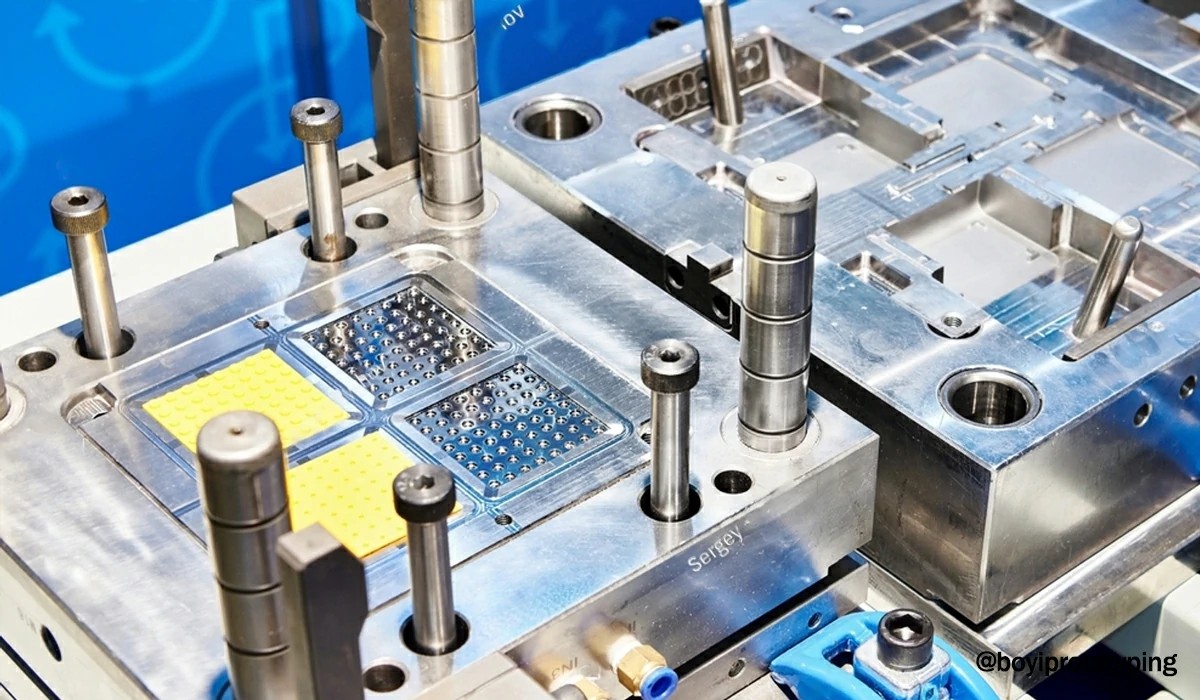
Layer one: tooling. The mold itself is a steel or aluminum block machined to the exact shape of your part. Tooling typically runs $5,000 to $80,000 depending on part size, complexity, and mold material.
Layer two: per-part cost. Once the mold exists, each shot of plastic runs about $0.10 to a few dollars. A single mold can produce tens of thousands to millions of parts before it wears out.
Here is how tooling cost usually breaks down by part size:
Part size
Typical tooling cost
Best mold material
Small (under 2 inches)
$5,000 – $15,000
Aluminum
Medium (2 – 6 inches)
$15,000 – $40,000
Aluminum or steel
Large (6+ inches)
$40,000 – $80,000+
Steel
We build steel and aluminum tooling in-house at our North Logan shop. That lets us size the mold to your real volume instead of over-tooling a job that does not need it.
The quote you see is not the full picture. Both methods have line items that surprise first-time buyers.
3D printing hidden costs:
Post-processing labor (sanding, support removal, painting)
Surface finish limits that may require secondary work
Wasted material from failed prints
Per-part cost that never drops at scale
Injection molding hidden costs:
Design for manufacturability review before tooling starts
Mold maintenance over the life of the tool
Minimum order quantities to justify a production run
Color or material changeover fees between jobs
There is also a big gap on design changes. A change after tooling is cut can mean a new mold or an expensive modification. The same change on a 3D printed part is almost free.
Lead time is the other gap. Injection mold tooling usually takes 4 to 8 weeks to build. A 3D printed part can be in your hand in days.
A simple DFM review often saves thousands in tooling. We once helped a client combine two molded parts into one, which cut their tooling bill in half.
Which Should You Choose for Your Project Stage?
The cheapest method depends on where your part sits in its lifecycle. Here is the quick map:
Project stage
Part count
Cheapest method
Why
Prototyping
1 – 100
3D printing
No tooling cost, fast iteration
Validation / pilot
100 – 1,000
3D printing
Tooling cost not yet justified
Bridge production
1,000 – 5,000
Injection molding (aluminum tool)
Lower-cost tooling, faster payback
Full production
5,000+
Injection molding (steel tool)
Lowest per-part cost at scale
The smartest path for most product teams uses both. Print parts to validate the design. Once the part is locked, move to injection molding for production.
This is where one roof matters. When the same team handles your prototype and your molded production run, your design files, material specs, and tolerance history stay in one place. No rebuilds. No lost context. No re-quoting from scratch.
Freeform Polymers offers both 3D printing and plastic injection molding in our North Logan, Utah shop. We are ISO 9001:2015 certified and work with clients across Northern Utah, Southern Idaho, and beyond. Call us at (435) 774-9090 and request a free quote today!
Should your part be plastic or metal? That question decides whether you need injection molding or die casting. Both processes push melted material into a mold under pressure. From across…
Is it cheaper to build your mold overseas or here at home? The honest answer depends on what you actually count. Many buyers compare domestic vs overseas injection molding using…
You have a part to make. Someone mentioned CNC turning or CNC milling. Maybe both came up. They sound alike, but they are not the same process. Picking the wrong…
You’ve probably seen the letters “ISO 9001:2015” on a badge or a website. It might look like just another logo. But it means something specific. ISO 9001:2015 certification tells you…
If you’ve gotten quotes from two injection molding companies, you may have noticed something. One mentions a hydraulic machine. The other mentions an electric machine. You might wonder if that…
Combining metal with plastic takes a different process than adding a soft grip to a hard plastic part. Both are common in insert molding and overmolding, but they solve different…
Not all injection molds are built the same way. At Freeform Polymers, we’ve seen how the type your part needs can change your tooling cost by thousands of dollars. That…
Ever gotten a design review back with a flag that says “insufficient draft”? You had no idea what that meant. It’s one of the most common notes molders give on…