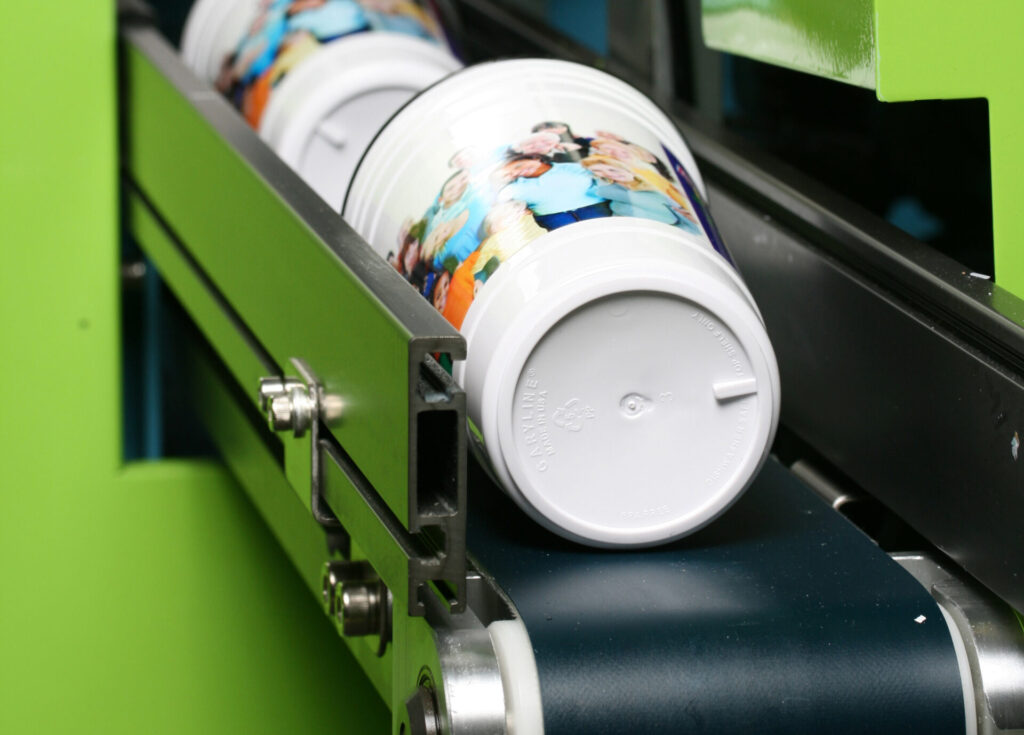
Does your part need a full-color logo, barcode, or photo-quality graphic? You may wonder if your manufacturer can even print that in-house. At Freeform Polymers, we use digital printing to add this kind of detail directly onto plastic parts.
This guide covers the applications of digital printing on manufactured plastic parts. We’ll give you a plain-language rundown you can use in just a couple of minutes. By the end, you’ll be able to tell if digital printing fits your project.
Here’s what we’ll walk through. First, the industries and part types where digital printing shows up most. Next, the real reasons manufacturers reach for it over other decorating methods. Last, where digital printing hits its limits, so you don’t apply it to the wrong job.
What Are the Applications of Digital Printing?
Digital printing on plastic parts is used for full-color logos, part numbers, barcodes, QR codes, warning labels, and photo-quality graphics. It shows up most in medical devices, consumer electronics, appliances, and short-run or prototype parts.
Digital printing skips the plate-making step. This makes it a smart choice for parts that change often, like custom branding runs.
See how it’s applied to real parts with our pad and digital printing service.
Where Digital Printing Shows Up in Manufacturing
Digital printing on plastic parts covers a wide range of industries and part types. Each one uses it for a different reason, but the technology behind it stays the same.
- Medical devices. IV bags, syringes, and catheters often need precise, repeatable markings for tracking and dosing.
- Consumer electronics and appliances. Housings and control panels often carry full-color logos or icons.
- Consumer goods. Products with photo-quality graphics or gradient designs benefit from digital’s flexibility.
- Short-run and prototype branding. Teams testing a design before full production use digital printing to add branding without committing to a plate.
Each industry picks digital printing for its own reasons. We’ll cover those reasons next.
Full-Color and Photo-Quality Graphics
Digital printing uses inkjet technology to lay down detailed, multi-color graphics straight onto a part. There’s no plate and no pad involved.
This makes it the right call for jobs that need more than a single-color logo. Multi-color designs, gradients, and photo-quality images all print cleanly with digital methods. QR codes, barcodes, and warning labels also come out sharp and easy to scan.
Because there’s no plate to etch, digital printing skips a setup step that other methods require. This keeps color-heavy designs practical, even on smaller runs.
Short Runs and Prototypes
Digital printing skips the plate-making step. That makes it a practical fit for smaller jobs and early-stage parts.
- No upfront tooling. There’s no plate to etch or pad to build before printing starts.
- Good for sampling. You can test branding and graphics before committing to full production.
- Flexible for design changes. Parts still in development can be reprinted without new tooling costs.
Still deciding on your production volume? Our guide on choosing the right run size can help.
If your part is still in the design phase, digital printing lets you add branding now and adjust later.
Digital Printing for Custom or Frequently Changing Parts
Some parts need marks that change from one unit to the next. Digital printing handles this without slowing down production.
Serialized parts, where each unit needs its own number or code, print well with digital methods. Personalized branding and private-label runs also work here, since artwork can change between print jobs with no new tooling required.
Designs that go through frequent revisions benefit too. You can update the file and print the new version right away.
Where Digital Printing Isn’t the Right Fit
Digital printing isn’t the best choice for every part. Knowing its limits helps you pick the right method the first time.
- Curved or textured surfaces. Flat inkjet methods struggle to reach deep curves, recesses, and textured surfaces the way a flexible pad can.
- Very high-volume runs. Once a plate is made, pad printing often costs less per part on large production runs.
Not sure which method fits your part? Contact us and we’ll help you figure it out!