You have a part idea. You don’t know what it will cost to make.
That’s the moment most first-time customers reach out to us at Freeform Polymers. They want to know how to calculate injection molding cost before they commit to a design. It’s a fair question, and it has a clear answer.
Manufacturers don’t guess at pricing. We build every quote from three line items: mold cost, material cost, and labor cost. Once you know these three numbers, you can estimate your own project cost on paper.
This guide walks you through that formula step by step. You’ll see how each cost is calculated. You’ll also see a worked example using a sample 5,000-unit order.
By the end, you’ll know how to build a rough estimate. You’ll also know when it’s time to stop estimating and request a real quote.
How Do You Calculate Injection Molding Cost?
You calculate injection molding cost by adding three numbers together.
Mold cost. This is a one-time tooling cost. It can range from $2,000 to $100,000 or more, depending on part complexity.
Material cost per part. Multiply the resin price by the weight of your part.
Labor and machine cost per part. Multiply your cycle time by the shop’s hourly rate.
To get your estimated cost per part, divide the mold cost by your expected quantity. Then add your material cost and labor cost per part.
The 3-Part Formula for Injection Molding Cost
Every injection molding quote comes down to three costs. Mold cost, material cost, and labor cost.
Mold cost is a one-time fee. You pay it once, no matter how many parts you order. Material and labor costs are different. They apply to each part you make, so they scale with your order size.
Add all three together and you get your total project cost. Later in this guide, we’ll walk through a worked example using a sample order.
Keep in mind, this formula gives you an estimate. It’s a starting point, not a formal quote.
Step 1: Estimate Your Mold (Tooling) Cost
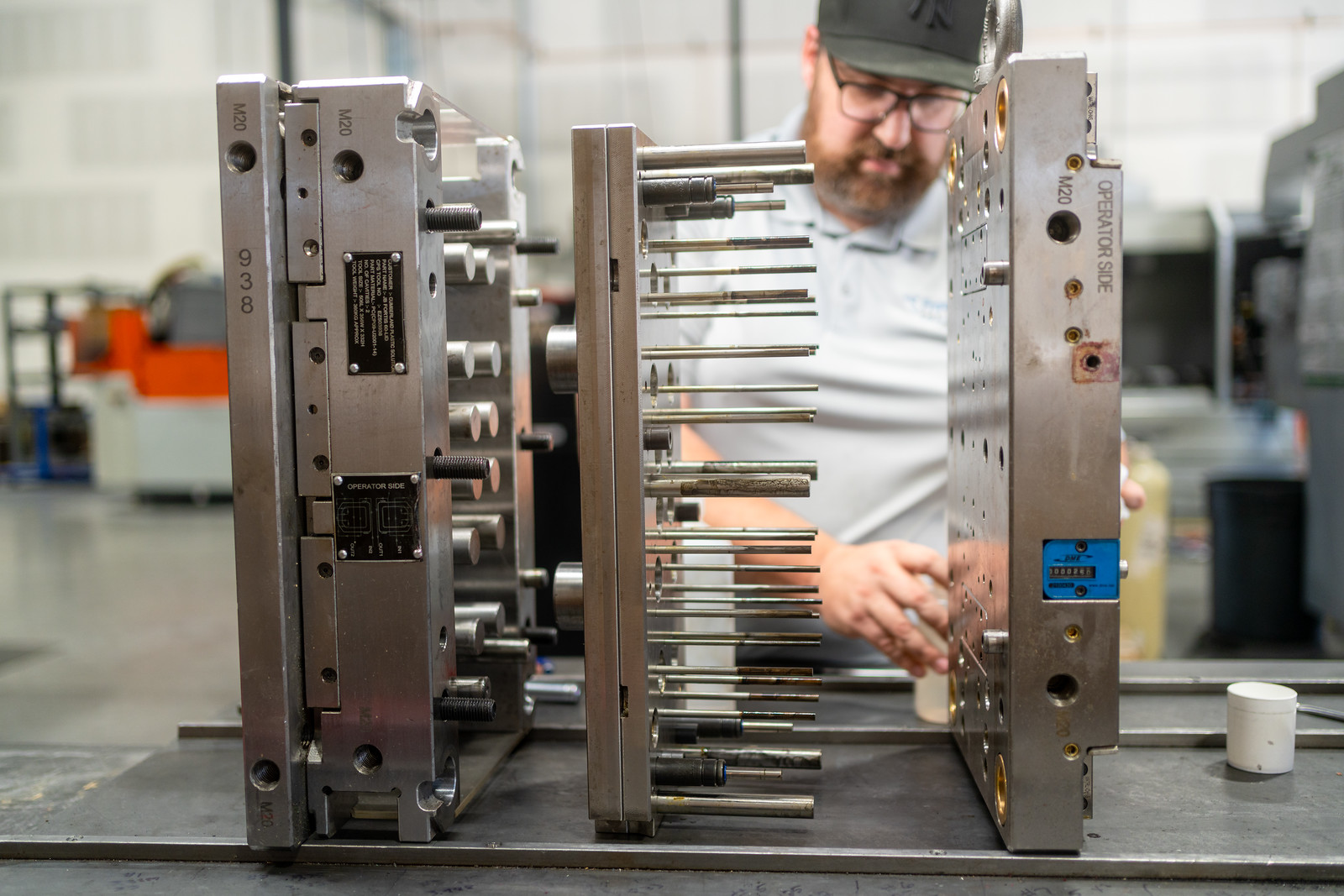
Your mold, or tool, is the first cost to estimate. It’s a one-time investment that produces every part you order.
Mold cost depends on the material used to build it. Aluminum molds cost less to build. They work well for lower production volumes and shorter mold lifespans. Steel molds cost more upfront. They last longer and handle high-volume production better.
Complexity also drives up mold cost. A part with tight tolerances, undercuts, or fine detail takes more time to tool. Cavity count matters too. A single-cavity mold costs less than a multi-cavity mold that produces several parts per cycle.
Across most projects, mold cost ranges from $2,000 to $100,000 or more. The final number depends on your part’s size, complexity, and expected volume.
When you scope a mold cost, start with your part’s complexity and your target volume. These two factors shape the price more than anything else.
Step 2: Estimate Material Cost Per Part
Material cost is your second line item. The formula is simple: resin price multiplied by part weight.
You can find your part’s weight two ways. Pull it from your CAD file, or weigh a physical prototype on a scale. Either method gives you an accurate number.
Resin price depends on the type of plastic you choose. Commodity resins, like polypropylene or polyethylene, cost less per pound. Engineering-grade resins, like nylon or polycarbonate, cost more. They offer added strength, heat resistance, or durability that commodity resins don’t.
Once you know your part weight and resin price, multiply the two together. That gives you your material cost per part.
Step 3: Estimate Labor and Machine Cost Per Part
Labor and machine cost is your third line item. This cost is based on cycle time and shop hourly rate.
Cycle time is how long it takes to mold one part, from injection to ejection. Most cycles run between 15 seconds and 2 minutes. Simple parts mold faster. Complex parts take longer.
Multiply your cycle time by your shop’s hourly rate. That gives you your labor and machine cost per part.
Complex geometry raises this cost. Thick walls, tight tolerances, and intricate features all add time to each cycle. More time per cycle means fewer parts per hour, which raises your per-part cost.
Worked Example: Calculating Cost for a Sample Part
Let’s walk through a sample order. This example is illustrative only. It is not a real quote.
Say you need 5,000 units of a small plastic housing.
Mold cost: $15,000, divided by 5,000 units = $3.00 per part
Material cost: Resin priced at $1.50 per pound, part weighs 0.1 pounds = $0.15 per part
Labor cost: 30-second cycle time, shop rate of $60 per hour = $0.50 per part
Add these three numbers together for your estimated cost per part.
Component
Estimated Cost Per Part
Mold cost (spread across 5,000 units)
$3.00
Material cost
$0.15
Labor and machine cost
$0.50
Total estimated cost per part
$3.65
This example shows how the formula works. Your actual numbers will depend on your part’s design, material, and volume.
When to Stop Estimating and Get a Real Quote
This formula gives you a solid starting estimate. It’s not a final number.
A manufacturer catches details a formula can’t. Design for manufacturability issues, material substitutions, and tooling adjustments all affect your final price. These variables show up during a real quote review, not a napkin calculation. Our extensive knowledge and experience helps us spot these issues early.
Local quotes turn around fast. You get real numbers, backed by a team that reviews your part’s specific design.
Ready to move past estimates? Contact us and request a free quote and get real numbers for your project!
You asked for a smooth, nice-looking part. Then the samples came back shiny, and every fingerprint and tiny dent showed. The mold did exactly what it was told. It just…
Your first sample parts look great until you flip one over. There’s a rough nub right on the face your customer sees first. That nub is where the plastic came…
Your first sample parts just came back. They look right until you tilt one toward the light. Then you see it: a shallow dent sitting right over a rib. Nothing…
Your CAD model says 25.00 mm. Your first molded parts come back at 24.93 mm. Is that a problem, or is it normal? The answer depends on the tolerance you…
A part passes inspection and ships out on time. Weeks later, it cracks after a solvent wipe or a tightened bolt. Nothing was wrong with the design. The stress was…
You design a part to be exactly 100 mm long. The first samples come back at 98.5 mm. Nothing went wrong on the press, and the mold wasn’t built wrong.…